Tom Waldrep Presents at North Carolina Critical Access Hospital Statewide Meeting

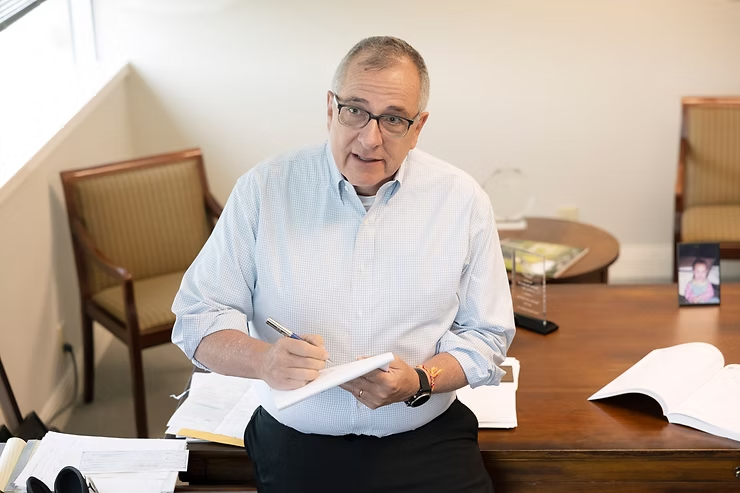
Attorney Tom Waldrep presented at the North Carolina Critical Access Hospital Statewide Meeting in Winston-Salem, NC on August 12, 2022. His presentation, “Perspectives From the Field – Key Issues Impacting Healthcare in NC,” focused on engagement with industry leaders regarding top issues impacting rural healthcare in North Carolina. Topics covered included addressing partnerships, provider, collaboration, staff engagement, and regulatory changes.

Attorney Jim Lanik Presents in Webinar

Attorney Jim Lanik will be presenting during a Webinar, “Trustee Security and Data Safety,” along with Justin Doles, Chief Information Security Officer for Stretto. The Webinar will be held on August 30, 2022 at 1pm ET and hosted by Stretto.

Stretto leverages best-in-class technology, along with deep-industry expertise and market insights, to facilitate every aspect of case and deposit management for its bankruptcy clients. As a trusted partner, professionals rely on Stretto to handle processes from start-to-finish so they can focus on more substantive case matters.

Deana Beni Joins Our Firm as Bookkeeper

Waldrep Wall Babcock & Bailey PLLC welcomes Deana Beni to our firm as our Bookkeeper. We are so glad to have you join us, Deana.

She joined the administrative team at the firm in 2022 and brought with her over 30 years of accounting and bookkeeping experience. Prior to joining the firm, Deana worked for 11 years as the Office Manager and Legal Assistant at Sallah Astarita & Cox, LLC in Boca Raton, Florida.

Deana performs daily accounting and financial reporting to ensure compliance and to maintain the firm’s operating and trust accounts.

Attorney Jim Wall Quoted in Medscape Medical News Article

Waldrep Wall Babcock & Bailey PLLC Attorney Jim Wall was quoted in a Medscape Medical News Article published in May 2022, “How a Separation Agreement Could Save Your Career,” written by Christine Lehmann.

Read Article

Medscape is the leading online global destination for physicians and healthcare professionals worldwide, offering the latest medical news and expert perspectives; essential point-of-care drug and disease information; and relevant professional education and CME.

Christine Lehmann. How a Separation Agreement Could Save Your Career – Medscape – May 20, 2022

Attorney John Van Swearingen to participate in the 2022 NCBJ/ABI Trial Skills Workshop

Waldrep Wall Babcock & Bailey PLLC Attorney John Van Swearingen was one of only 16 young bankruptcy practitioners nationwide chosen to participate in the 2022 National Conference of Bankruptcy Judges (NCBJ) / American Bankruptcy Institute (ABI) Trial Skills Workshop to be held this October in Orlando, Florida.

The National Conference of Bankruptcy Judges is an association of the Bankruptcy Judges of the United States which has several purposes: to provide continuing legal education to judges, lawyers and other involved professionals, to promote cooperation among the Bankruptcy Judges, to secure a greater degree of quality and uniformity in the administration of the Bankruptcy system and to improve the practice of law in the Bankruptcy Courts of the United States.

NCBA Minorities In the Profession Committee Diverse Attorney Networking Social

Waldrep Wall Babcock & Bailey PLLC Attorney Diana Santos Johnson and Summer Associate Marcus Tingling attended the North Carolina Bar Association Minorities In the Profession Committee Diverse Attorney Networking Social last night at Top Box at the Boxyard in RTP. The both had a great time supporting this wonderful event!

The NCBA Minorities in the Profession Committee (MIP) is dedicated to promoting an increased presence of minorities in the legal profession; the ongoing education of minorities in the legal profession; the betterment of life for those minorities in the legal profession; providing the public with quality information regarding issues of concern to minority lawyers; and educating the public about the contributions of North Carolina’s minority lawyers.

Is Your Pay Plan Stark Compliant?

By: James D. Wall, Esq.

Generally, the physician’s self-referral law (often referred to as “Stark”) prohibits a physician from referring a patient whose services may be reimbursed by a government payor (e.g., Medicare) for certain “Designated Health Services” (“DHS”) to an entity in which the physician or immediate family member of the physician has a financial relationship, unless an exception applies. “Designated Health Services” is defined to be ancillary goods or services reimbursed by Medicare, and include (i) clinical laboratory services, (ii) physical and occupational therapy services, (iii) radiology and other imaging services, and (iv) durable medical equipment. Stark defines DHS by reference to certain CPT codes, a list of which is published each year and can be found at https://www.cms.gov/Medicare/Fraud-and-Abuse/PhysicianSelfReferral.

Physician practices that provide DHS implicate the Stark prohibitions because the physicians in the practice order tests, goods or services to be performed or provided by the practice. For example, if a physician orders lab tests to be performed by a laboratory that is owned by the practice, the Stark law is implicated. Same would be true for a cardiologist ordering imaging services to be done in-house, or an orthopedist ordering physical therapy services. In these examples, physicians would be referring tests to an entity (i.e., their practice) in which the physician owns an interest.

Like many regulatory paradigms, the prohibition is broadly defined, but exceptions carve out behavior that the government does not want to prohibit. While a deep dive into each exception is beyond the scope of this article, a prevalent exception for referrals within the same practice is the In-Office Ancillary Services Exception (IOASE). In order to rely on IOASE, a practice must meet the definition of a “group practice” under Stark. IOASE protects the in-office provision of certain DHS that are ancillary to the medical services provided by the physician practice. IOASE requires services to be personally provided by the referring physician, a physician-member of the same group practice as the referring physician, an individual who is supervised by the referring physician, or if the referring physician is a group practice, by another physician in the group practice, provided the supervision complies with all Medicare care payment/coverage rules for the services.

Second, IOASE requires that services be furnished in the same or centralized building. There are three alternative tests for this location requirement, but only one must be met. All three tests require the referring physician to have offices in the building that are open to patients a minimum number of hours per week and the physician must regularly practice medicine and furnish physician services for a minimum number of hours per week in that office. Additionally, IOASE requires the DHS to be billed by the physician group practice performing and supervising the services, or by an entity fully owned by the physician or the physician’s group practice (or by an independent third-party billing company acting as an agent for the group practice).

Compensation Arrangements

Regulations promulgated under Stark prohibit physicians from being paid based on the “volume or value” of their referrals of DHS. This has generally prohibited group practices from paying physicians based upon the specific orders or prescriptions for DHS provided by the group practice. Additionally, Stark regulations allow practices to split profits from DHS either on a share and share-alike basis, or based on the physician’s production excluding DHS compared to the production (excluding DHS) of other participating physicians in the practice.

New Regulations Clarify Physician Compensation

New regulations promulgated effective January 1, 2022 require compensation arrangements to meet certain criteria in order for the practice to enjoy the designation of a “group practice” under Stark.

The requirements for a group practice can be summarized as follows:
 

  • Practices should not pay physicians for DHS the physicians order, either by counting the revenues or profits from the referrals in the physician’s production or using the revenues or profits to calculate a productivity bonus.
  • A practice may pay a productivity bonus based solely on a physician’s personally performed services (these services are not “referrals” because they are personally performed by the physician).
  • A practice can distribute profits from DHS and not be deemed to be paying physicians based on the “volume or value of referrals” by distributing the profits in one of the following manners: (i) per capita; or (ii) based on distributions of the group’s revenues attributed to services that are not DHS and would not be considered DHS if the service had been paid by Medicare even if the service was paid by a private payer.
  • A practice may use certain criteria to pay productivity bonuses to ensure that the bonus is not based on the “volume or value of referrals” of DHS: (i) the productivity bonus is based on the physician’s total patient encounters or the RVUs personally performed by the physician; or (ii) the services on which the productivity bonus is based are not DHS and would not be considered DHS if they were payable by Medicare.
  • Practices may have an exemption from these rules if revenues derived from DHS constitute less than 5 percent of the group’s total revenues, and the portion of those revenues attributed to each physician in the group constitutes 5 percent or less of his or her total compensation from the group.


Notably, the oft-used method of carving out government payer business does not work. In order to enjoy the designation of a “group practice” under Stark, the services on which the productivity bonus is based cannot be DHS nor can they be DHS if they were payable under Medicare. Thus, pay plans that may once have been compliant may have fallen out of compliance.


Ciara L. Rogers to Speak at NABT 2022 Annual Conference

Attorney Ciara L. Rogers will be speaking at the National Association of Bankruptcy Trustees (NABT) 2022 Annual Conference in Vancouver, British Columbia on June 10. Her presentation, “Discharges in Subchapter V, What Has Changed from Chapter 11, What Remains the Same,” will discuss how the Small Business Reorganization Act has altered the timing and breadth of the Chapter 11 discharge in Subchapter V cases. This session seeks to dive into what has changed with the Chapter 11 discharge in Subchapter V cases, what has remained the same, and how courts are interpreting these new provisions. Have fun and safe travels, Ciara!

Jennifer Lyday to Speak at NABT 2022 Annual Conference

Attorney Jennifer Lyday will be speaking at the National Association of Bankruptcy Trustees (NABT) 2022 Annual Conference in Vancouver, British Columbia next week on June 9. Her presentation, “Show Me the Money: Practical Issues at the Intersection of Subchapter V Trustees and Estate Funds,” will discuss how to navigate the many issues at the intersection of Subchapter V Trustees and money such as: the duties that come into plan when Subchapter V trustees are handling estate funds; the circumstances under which a Subchapter V trustee may be required to handle estate funds; whether Subchapter V trustees must always distribute the money in non-consensual plans; whether Subchapter V trustees can be forced to distribute the money in consensual plans; the mechanics of and strategies for distributing money in Subchapter V cases; how and when to request approval of Subchapter V fees; what types of fees are being approved for Subchapter V fees; and tax reporting considerations. Have fun and safe travels, Jennifer!

WWBB Attorneys Jennifer B. Lyday and Diana Santos Johnson Volunteer for Pro Bono Programs

Congratulations to Waldrep Wall Babcock & Bailey PLLC Attorneys Jennifer B. Lyday and Diana Santos Johnson who are now attorney volunteers for the Pro Bono programs offered in the Middle District and Eastern District Bankruptcy Courts. The pro bono programs provide a volunteer attorney to assist certain unrepresented parties that are unable to employ an attorney on their own behalf (pro se) with adversary proceedings and certain contested matters.