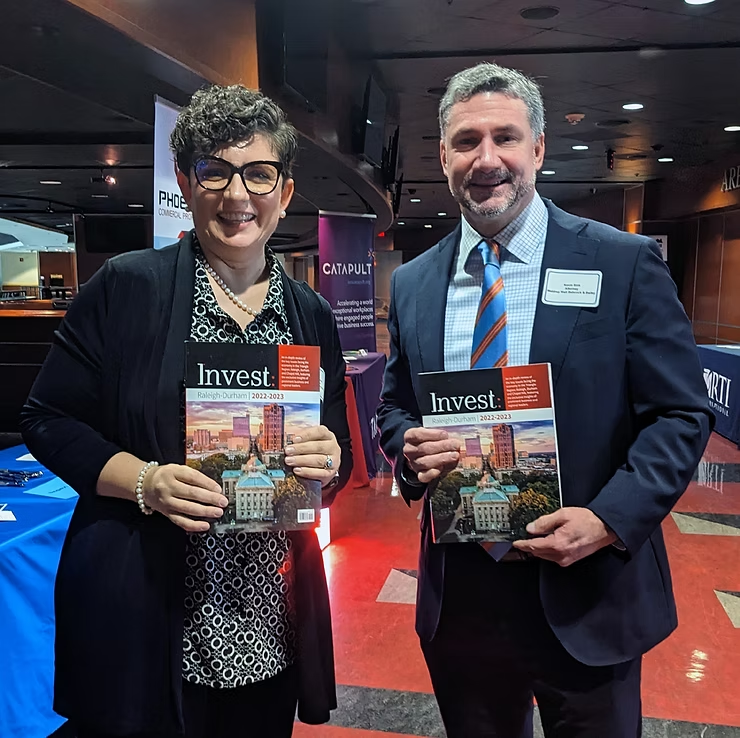
Attorney Kevin L. Sink Featured in the 2022-2023 Issue of Invest: Raleigh-Durham

Waldrep Wall Babcock & Bailey PLLC Attorney Kevin L. Sink was interviewed and featured in the 2022-2023 issue of Invest: Raleigh-Durham regarding the legal and professional outlook in the Raleigh-Durham area. WWBB Attorney Jennifer B. Lyday attended the publication launch party with Kevin on Thursday, January 19, at the PNC Arena in Raleigh.

Click here to read the 2022-2023 issue of Invest: Raleigh-Durham.

Invest: Raleigh-Durham is an in-depth review of the key issues facing the economy in the Triangle Region: Raleigh, Durham and Chapel Hill. The 200-page publication features in-house analysis, supporting data and statistics, alongside exclusive insights from prominent industry leaders. Unique in their approach, their teams speak with more than 200 top public and private sector leaders from across key economic industries over the course of a six to eight month research period.

Tom Waldrep, Kevin Sink, and John Babcock Receive Prestigious Recognition

Waldrep Wall Babcock & Bailey PLLC Attorneys Tom Waldrep, Kevin Sink, and John Babcock were recently selected by Business North Carolina Magazine to the 2023 22nd Class of Legal Elite. Since 2002, Business North Carolina Magazine has honored Tar Heel lawyers by publishing Business North Carolina’s Legal Elite, a listing of the state’s top lawyers in business-related categories. Winners are chosen by the state’s lawyers. Business North Carolina’s Legal Elite has become the model for other awards and lists, but it remains unique as the only award that gives every active lawyer in the state the opportunity to participate. Business North Carolina’s Legal Elite includes top lawyers chosen using this statewide ballot.

Congratulations on such a prestigious honor!

Several WWBB Attorneys Receive Prestigious Recognition

Several of the Waldrep Wall Babcock & Bailey PLLC Attorneys were recently selected to the 2023 North Carolina Super Lawyers or 2023 North Carolina Rising Stars List! Congratulations!

Tom Waldrep: 2023 North Carolina Super Lawyer

Jim Wall: 2023 North Carolina Super Lawyer

Dennis Bailey: 2023 North Carolina Super Lawyer

John Babcock: 2023 North Carolina Super Lawyer

Joe Carruthers: 2023 North Carolina Super Lawyer

Kevin Sink: 2023 North Carolina Super Lawyer

Jennifer Lyday: 2023 North Carolina Super Lawyer

Ciara L. Rogers: 2023 North Carolina Rising Star

John Van Swearingen: 2023 North Carolina Rising Star

NC Medical Board Proposes Position Statement on Licensee Employment With Hospitals, Group Practices and Other Health Systems

By: James D. Wall, Esq.

The North Carolina Medical Board recently proposed a Position Statement on physician employment with hospitals and other large groups.  A Position Statement is not a law or regulation, but rather the Medical Board’s interpretation of existing laws or regulations that govern the practice of physicians, physician assistants and nurse practitioners.  Position Statements give practitioners a road map for compliant and ethical practice.  One would disregard a Position Statement at his or her peril.

What’s the Problem?

While the Board is clear to state that the existence of a Position Statement should not be taken as an indication of the Board’s enforcement policies, it only stands to reason that the Board would have, or anticipates having, some concerns about the “shift from licensees practicing in personally owned practices toward licensees practicing while subject to employment and other contractual relationships with hospitals, group practices and other health systems.”  (Proposed Position Statement 9.1.3., Licensee Employment, p.1).

Know The Structure

The Board expects licensees to know the organizational structure of the employer.  I don’t think this means a physician must memorize the org chart of a multi-billion dollar system.  I believe this advice is more elementary.  Physicians are sometimes employed by start-ups or practices that have  relationships with management service organizations (MSOs), and they often conflate the MSO with the managed practice.  With few exceptions, physicians cannot be employed by a lay corporation to deliver professional services on behalf of that lay corporation.  Physicians may, however, be employed by licensed hospitals and HMOs.  With the increase of MSOs, it is important for physicians to know that the MSOs cannot employ physicians to render professional services.  The licensee’s employment agreement should be with the medical practice, and the remuneration should be paid by the medical practice.  The physician should know the difference between the practice and the MSO, and keep the line between the two clear and in focus.

Employment Agreements Are Real

The employment agreement should be consistent with the employment relationship.  The Board provides in the proposed Position Statement, “Employment Agreements are legal documents. Licensees should seek their own legal counsel before signing them.”  The Position Statement also provides that employment agreements should be negotiated in “good faith” and that both parties should engage legal counsel “experienced in physician employment matters.”  It is obvious that I would mention this, analogous to the barber extolling the virtues of a haircut; but I think it is telling us more.  The takeaway to licensees is “do not tell us you did not know what was in your employment agreement, or that you did not understand it.”  Physicians are forewarned.

Know What is Expected of You

Physicians are required to know the policies and protocols of their employers.  The Board will have little tolerance for a physician’s attempt to defend his or her actions because an employer steered the physician away from doing the right thing.  Further, ancillary to this point is the Board expects physicians to associate with ethical employers.  A physician cannot hide behind an employer when taken to task.  In fact, the Position Statement goes so far to say that you need to “Recognize that your obligation to provide care that conforms to the standards of acceptable and prevailing medical practice, or the ethics of the medical profession, may require you to leave a situation that does not allow you to provide such care.”  This is the “Johnny Paycheck[1] option.”  In short, if your employer is making you do something you believe to be short of acceptable and prevailing standards of medical care, the Board expects you to resign.

A Supervisory Role Doesn’t Insulate You

The Position Statement is specific: if your position removes you from direct patient care “such as a medical director or vice president of medical affairs . . . [such a role] does not remove you from professional ethical obligations.”  The Board provides that “patient welfare must take priority in any situation where the interests of licensees and employers conflict.”

Guidance to Employers Is Plentiful

The proposed Position Statement cites the American Medical Association’s “Principles for Physician Employment” AMA H-22.950 which indicates that employed physicians “should be free to exercise their personal and professional judgment in voting, speaking and advocating on any manner regarding patient care interests, the profession, health care in the community and the independent exercise of medical judgment.  Employed physicians should not be deemed in breach of their employment agreements, nor be retaliated against by their employers, for asserting these interests.”

Further, the Position Statement indicates that while physicians typically assign billings to employers, “employed physicians or their chosen representatives should be prospectively involved if the employer negotiates agreements for them for professional fees, capitation or global billing, or shared savings.  Additionally, employed physicians should be informed about the actual payment amount allocated to the professional fee component of the total payment received by the contractual arrangement.”  Position Statement, p. 5.

Conclusion – Patient Welfare is the Guidepost

The Position Statement is replete with references to patient welfare trumping the relationship between the employed physician and his or her employer.  For example, patients should be notified when a physician departs from the practice, and informed of the physician’s new contact information.  Further, the Position Statement cites the AMA “A physician’s paramount responsibility is to his or her patients.”  The AMA recognizes the inherent conflict of interest with the physician’s duty to his or her patients and the duty of loyalty owed to the physician’s employer.  “This divided loyalty can create conflicts of interest, such as financial incentives to over- or under-treat patients, which employed physicians should strive to recognize and address.”  It is clear, however, that the “employer-made-me-do-it” will not be an acceptable defense.

[1] Johnny Paycheck was a popular country music singer in the 70’s whose biggest hit was “Take This Job and Shove It,” a working man’s anthem at the time written by David Allen Coe.

Jennifer Lyday Presents at the ABI Annual Winter Leadership Conference

Attorney Jennifer B. Lyday recently attended the American Bankruptcy Institute (ABI) Annual Winter Leadership Conference in sunny Southern California held this year at the La Quinta Resort & Club from December 8th – 10th, 2022.

On December 9, Jennifer participated in a presentation, “Evidentiary Issues in Bankruptcy: Making Your Case,” with the Hon. Christopher M. Lopez, U.S. Bankruptcy Court (S.D. Tex.), Houston; Adine S. Momoh, Stinson LLP, Minneapolis; and Jason N. Zakia, White & Case LLP, Chicago.

The Conference featured topics designed for consumer and business practitioners, as well as financial advisors. As always, the conference provided numerous social and fun events to network and renew friendships with colleagues from around the nation and overseas.

A Pro Bono Experience: Assisting First Church of God in Christ in Stopping the Foreclosure of Their Church 

By: Diana Santos Johnson

First Church of God in Christ is a thriving church in Winston-Salem, North Carolina. They have owned their worship space property – which contains a building valued at almost $1 million – for 23 years. Like most commercial real estate owners, First Church had a five-year term on the loan that was secured by their church property. When the term ended in February 2022, the lender was not willing to work with First Church to extend the term or give them additional time to refinance the loan, despite having an excellent payment history and substantial equity in the property.
 

Within a few months of the term due date, the lender filed a foreclosure action in Forsyth County.  First Church initially contacted Waldrep Wall Babcock & Bailey PLLC to explore the possibility of filing bankruptcy to stop the foreclosure action. After determining that bankruptcy would not be the right fit in this situation and would be too costly, attorneys Jennifer Lyday and Diana Johnson, along with the Waldrep Wall Babcock & Bailey PLLC bankruptcy team, decided to assist the church pro bono – without a charge – to delay the foreclosure action long enough for First Church to find another lender to refinance the loan.
 

Waldrep Wall Babcock & Bailey PLLC attorneys also assisted First Church in submitting documents to the new lender and in explaining the new loan terms. Eventually, First Church was able to secure a ten-year term with a new lender and was able to obtain additional funds to replace their existing air conditioning units.
 

Waldrep Wall Babcock & Bailey PLLC also coordinated with attorney Patti Dobbins, of Patti D Dobbins Attorney at Law, PLLC, to do the refinance loan closing pro bono. Attorney Dobbins coordinated a closing date that was flexible for the First Church board, prepared the necessary closing documents, and filed all the necessary paperwork to complete the refinance.  First Church was able to close on the new loan on August 25, 2022. After the new loan closed, the foreclosure action was dismissed, and First Church was no longer at risk of losing their church home of over 20 years. First Church Pastor Bernie Cundiff stated, “Jennifer, Diana, and the team at Waldrep Wall Babcock & Bailey PLLC went the extra mile for us. They helped us every step of the way with excellence, and it was truly ‘The Hand of the Lord’!”
 

Lisa Lash, First Church Secretary, stated, “We have been extremely blessed to have worked with such an extraordinary team! Jennifer and Diana were truly engaged in every phase of the process. Equipped with all the knowledge necessary to complete a case such as ours, they guided us with professionalism and confidence – always there to support us with an eagerness to see us succeed. We will forever be grateful for their diligence, work ethic, and their sincere compassion for our church.”
 

Pro Bono Initiatives at Waldrep Wall Babcock & Bailey PLLC

Waldrep Wall Babcock & Bailey PLLC is committed to serving the most vulnerable in our society with legal, social, and economic issues through pro bono service. The firm regularly provides pro bono representation to individuals and non-profit entities in need. The firm’s attorneys look for opportunities to use their education and experience to be of service to their fellow North Carolinians and take to heart their professional obligations as lawyers to make a difference.
 

About Waldrep Wall Babcock & Bailey PLLC

Attorneys at Waldrep Wall Babcock & Bailey PLLC are experienced in assisting commercial property owners avoid foreclosure, and our team can guide you to the best possible resolution of your business’ financial problems.
 

Waldrep Wall Babcock & Bailey PLLC is a business law firm focused on bankruptcy, commercial transactions, healthcare, commercial real estate, litigation, mediation, education law, and municipal law. Through our highly experienced attorneys, we serve clients with efficiency and expertise, both inside and outside of the courtroom.
 

Our firm employs a different approach – one that is client-centric and encourages a collaborative team culture that is data driven, tech-enabled, and multidisciplinary. We focus on offering solutions to our clients, which involves selecting the right attorneys in our firm to guide your specific business and legal needs. With Waldrep Wall Babcock & Bailey PLLC, you don’t just hire an attorney, you engage the expertise of our entire firm.

Jennifer Lyday Was Recently Chosen To Serve On the IWIRC 2023 Board of Directors

The International Women’s Insolvency and Restructuring Confederation (IWIRC), the premier international, networking and professional growth organization for women in the restructuring and insolvency industry, recently announced its 2023 Board of Directors, and Waldrep Wall Babcock & Bailey PLLC Attorney Jennifer B. Lyday was chosen to be on the Board as Vice Director of News.

The complete list of directors can be found by clicking here.

Leyza Blanco (Sequor Law, Miami), past Chair and Chair of the 2023 Nomination Committee announced, “IWIRC’s 2023 Board of Directors is a reflection of the diversity and talent of IWIRC’s members and worldwide presence. As we head into IWIRC’s 30th Anniversary year, I am excited to see what IWIRC has in store for the future.”

Marjorie Kaufman (The Christmas Tree Shops, Boston), a dedicated, insightful and energetic long time member of IWIRC, will be the Chair for 2023. Margie stated “IWIRC is the premier women’s restructuring networking organization spanning the globe. I am honored to be leading such a prestigious association, as we continue to add new networks and enhance networking opportunities for women in restructuring around the world.”

The other officers include Karen Fellowes (Stikeman Elliott, Calgary/Vancouver), Vice-Chair; Evelyn Meltzer (Troutman Pepper Hamilton Sanders LLP, Wilmington), Secretary; and Eloise Matsui (Omni Bridgeway, Hong Kong), Finance Director. New to the Executive Committee is Tara Schellhorn (Riker Danzig Scherer Hyland & Perretti LLP, Morristown, NJ), Vice Finance Director.

Tara shared, “I’m thrilled to be joining the Executive Committee this year as IWIRC celebrates its 30th anniversary. I am looking forward to working alongside this group of talented and passionate leaders to help continue to grow IWIRC and further our mission. IWIRC has been, and continues to be, a critical part of my professional development. I am grateful to be afforded the opportunity to give back to an organization that has already given me so much.”

Jennifer Kimble (Lowenstein Sander, New York), outgoing Chair said, “The growth of IWIRC over the last year has been astounding as IWIRC welcomed new members and new networks, including IWIRC’s first network on the continent of Africa. It’s been an absolute privilege to lead IWIRC and its Board of Directors in carrying out IWIRC’s mission of connecting, advancing and promoting women. I have no doubt that Marjorie Kaufman and the 2023 Board of Directors will continue to build on the successes of the last year as IWIRC celebrates its 30th Anniversary.”

About IWIRC

The International Women’s Insolvency & Restructuring Confederation (IWIRC) is committed to the connection, promotion, and growth of women in insolvency and restructuring professions worldwide. Since 1994, IWIRC has been connecting women worldwide through a global membership of more than 2,100 attorneys, bankers, corporate-turnaround professionals, financial advisors, and other restructuring practitioners. The organization provides its members with relationship-building, educational, career enhancement, and promotional opportunities.

Selling Your Practice? Consider These Issues First

There has been a resurgence of practice acquisitions of late. If you are an owner in your practice, chances are you are considering selling your practice or soon will be. Other than purchase price, which is the bait on the hook, what else should you consider?

Who’s Your Buyer?

In general, there are three types of buyers. First, there are hospital buyers. With few exceptions, our recent experience has been that hospitals pay practices the fair market value of tangible assets. Often, the “value” is achieved by more lucrative employment agreements as a result of the hospital system’s reimbursement rates that are more favorable than what a private practice might negotiate. There is not a lot of money transferred at closing.

The second types of buyers are other practices. Often, acquirers have built an efficient practice, and believe that they can squeeze inefficiencies out of smaller practices and make them more profitable. These acquirers usually have methods and processes that, when shared, make the acquired practice more profitable and thus more valuable.

These acquirers may have a long range plan of building a bigger practice, which would make them more valuable to the third type of buyer, private equity backed management service organizations, or “MSOs”. While some MSOs are not backed by private equity, we will assume for the purposes of this discussion, that they are. This type of transaction involves the MSO purchasing the non-clinical assets of a practice, including goodwill. The practice owners often sell their ownership in the practice to a physician who may be “friendly” with the MSO. The friendly physician, simultaneous with the closing, causes to enter into a long term management services agreement (MSA) with the MSO. These types of transactions have become popular among practices because, well, adult money changes hands at closing. The MSO receives a return on its investment through the fees paid under the MSA. Often, these fees are paid from the reduced compensation of the providers in the practice. Further, in many of these transactions, owners in the practice are required to “roll-over” purchase price into the MSO as an investment.

What Is Your Timing?

Often, timing can dictate the type of purchaser whom you pursue. We have helped smaller practices whose founder has experienced health issues and must transition his or her practice on a short time frame. Founders often do this to transition loyal employees and to address the nightmarish administrative burden of administering patient charts of a closed practice. In those cases, hospitals or other practices may be a better fit because there is often a prior working relationship between the buyer and seller.

Donating Your Practice

Another exit strategy is for the founding physician to donate his or her practice to a non-profit hospital. With some significant caveats, a physician may be able to deduct as a charitable contribution the appraised value of his or her practice. This allows the physician to meet his or her transition goals with respect to employees and patient charts, while at the same time giving him or her significant tax advantages that may outweigh mere liquidation value of the practice.

What Are Your Goals?

If you have plenty of time to search for a buyer, then your goal is to obtain the most value for your practice. This is not only a function of purchase price, but also depends on the tax treatment of the consideration you receive. For example, if your practice is a C corporation and you sell assets, the corporation will pay tax on the gain resulting from the sale, and the C corporation’s shareholders will pay tax on the dividend they receive as a result of the sale. C corporation dividends are not deductible by the C corporation.  As a result, this phenomenon is often referred to as a “double tax” since the C corporation pays tax on the gain and the shareholders pay tax on the resulting dividend.

The goal should be to structure the transaction so that there is no double tax, that the proceeds received by the owners are taxed at what have been lower capital gains rates, and that the tax on any roll-over equity be deferred until that roll-over equity is liquidated. This is often easier said than done.

Second Bites of the Apple

As a general rule, if practices sell to private equity, they are often valued based on a multiple of “EBITDA,” which is “earnings before interest, taxes, depreciation, and amortization.” Also, as a general rule, larger practices can often command a higher multiple of EBITDA than a comparably run smaller practice. One way to think of this is that one practice with 100 providers would be more valuable than the sum of the value of 50 practices with two providers each. This matters because with practice and MSO acquirers, the selling physicians may be asked to roll-over equity into the new enterprise. The goal of course is that the new enterprise will grow and prosper, and the rolled over equity will create another liquidity event for the physicians.

Not as Easy as It Looks

The complexity of a sale is often dictated by the type of buyer. In a hospital transaction, there is usually an asset purchase agreement and employment agreements for the providers. Since hospitals are exempt from the prohibition on the corporate practice of medicine, they can either directly employ the acquired physician, or own an operating LLC that does so. Further, an acquiring practice can directly employ the acquired physicians. The rub comes when lay companies like MSOs are purchasing non-clinical assets. Because MSOs cannot own medical practices, the transactions involving their relationships with medical practices are often fraught with peril. In short, don’t try this at home.

Key Advantages of Chapter 12 Bankruptcy for Struggling Family Farmers

By: James C. Lanik and Jennifer B. Lyday

American family farmers and family fishermen Display footnote number:1 are not immune to the effects of the current condition of the general economy. A recent industry analysis indicates that the three most pressing concerns of respondents surveyed in September 2022 were: 1) higher input costs; 2) rising interest rates; and 3) availability of inputs. Display footnote number:2 These factors are squeezing family farmers from all sides.

Needed inputs, such as fertilizer, feed, seed, etc., are becoming more expensive, if they can be had at all. At the same time, the capital needed to purchase those inputs is becoming more expensive to obtain. These trends, along with the ever-present issue of weather, may lead more farmers to seek out bankruptcy protection to maintain their livelihoods and, in some cases, to hold on to land that may have been in their families for generations.

Congress created a specialized chapter of bankruptcy—Chapter 12—in the 1980s to help struggling farmers reorganize their businesses and their debts. Display footnote number:3 A Chapter 12 bankruptcy has similarities to both a Chapter 11 reorganization and a Chapter 13 case, but significant and important differences exist between the chapters. This article provides a brief overview of some of the more material differences.

Eligibility

Chapter 12 was designed to provide farmers a structure to reorganize their business and continue to pay their debts. Thus, only certain individuals and entities can file under Chapter 12. Section 109 of the Bankruptcy Code Display footnote number:4 provides that only a farmer with regular annual income may be a debtor under Chapter 12. A farmer who exceeds the debt threshold or otherwise cannot meet the Chapter 12 requirements can still file under Chapter 11.

A “family farmer” is defined in Section 101(18) of the Bankruptcy Code as an individual or individual and spouse engaged in a farming operation:
 

  • With total debts (secured and unsecured) that do not exceed $11,097,350;
  • With at least 50 percent of the total debts that are fixed in amount (exclusive of debt for the debtor’s principal residence unless the debts arise out of a farming operation) arising out of a farming operation; and
  • Receiving more than 50 percent of the gross income of the individual or the individual and spouse for the preceding tax year, and for each of the second and third prior tax years, from the farming operation.


A “family fisherman” is defined in Section 101 (19A) and Section 109 as an individual or individual and spouse engaged in a commercial fishing operation:

  • With total debts (secured and unsecured) that do not exceed $2,268,500;
  • With at least 80 percent of total debts that are in a fixed amount arising out of a commercial fishing operation; and
  • Who receives more than 50 percent of the gross income of the individual or the individual and spouse for the preceding tax year from the operation.


A corporation may also qualify to be a Chapter 12 debtor. Section 101(18B) has the following requirements for a corporate Chapter 12 debtor:
 

  • More than 50 percent the outstanding stock or equity in the corporation or partnership must be held by one family, or by one family and its relatives;
  • The family must conduct the farming or commercial fishing operation;
  • More than 80 percent of the value of the corporate or partnership assets consists of assets relating to the farming or fishing operation;
  • Total debt of the corporation or partnership must not exceed $11,097,350 (farming operation) or $2,268,550 (commercial fishing operation);
  • At least 50 percent for a farming operation or 80 percent for a fishing operation of the corporation’s or partnership’s total debts which are fixed in amount (exclusive of debt for a principal residence by a shareholder or partner unless such debt arises out of a farming or commercial fishing operation) must arise out of the farming or fishing operation; and
  • If the corporation issues stock, the stock cannot be publicly traded.


Unlike in a Chapter 11 case, the automatic stay in a Chapter 12 also extends to co-debtors on consumer debts but not to debts incurred in the ordinary course of business; this stay is identical to the co-debtor stay in a Chapter 13 case Display footnote number:5.

Lower Fees

Once the eligibility determination has been made, the first material difference for a Chapter 12 debtor is the lower fees. Filing fees are only $278 for a Chapter 12 compared to $1,738 for Chapter 11. Display footnote number:6 Also, the quarterly fees of 28 U.S.C. § 1930 do not apply in a Chapter 12 bankruptcy, and the standing trustee fees based on plan disbursements can be much lower for a Chapter 12 case than for a Chapter 11 case. Display footnote number:7

The Trustee

In every Chapter 12 bankruptcy case, a disinterested trustee is appointed. Display footnote number:8 The trustee’s duties are typically to provide additional oversight of the bankruptcy case. However, the trustee must be heard on matters pertaining to the value of property subject to a lien, confirmation of a plan, modification after confirmation, or the sale of the property of the estate. Display footnote number:9 The trustee is paid through the plan and is also paid a percentage of plan disbursements. Display footnote number:10 Periodic reports are also required in Chapter 12 plans. Display footnote number:11

The Plan

Chapter 12 plans have many significant differences to plans under Chapter 11; some benefit the farmer, but others can be more onerous. A sampling of those differences includes:

  • No exclusivity period exists under Chapter 12. The debtor is the only entity that can ever file a plan. Display footnote number:12
  • That exclusivity is offset by the quick deadlines for filing the plan. The debtor must file a plan within 90 days of the filing of the petition, while in a Chapter 11 case, no set deadline exists other than the exclusivity period. The 90-day deadline can be extended only for situations beyond the control of the debtor. Display footnote number:13
  • No disclosure statement is required, much like in Subchapter V cases.
  • With respect to how much a farmer must pay, a Chapter 12 plan more closely resembles a Chapter 13 plan. A Chapter 12 plan must, among other things: provide future earnings/ income to the trustee; pay in full all priority claims under Section 507; and if the plan classifies claims, treat all claims in a class the same. Display footnote number:14
  • A Chapter 12 plan may provide for some or all the following: designation of classes of claims; modification of the rights of secured creditors; cure of defaults; payments to unsecured creditors; assumption of unexpired leases and executory contracts; and sale or distribution of property; modification of home mortgages; and the vesting of property in the debtor at confirmation or some other time. Display footnote number:15
  • The plan can last up to three years, though the court can extend that period to no more than five years, for cause.

Plan Confirmation

Continuing with the expedited nature of a Chapter 12 case, the confirmation hearing must occur with 45 days after the debtor files the plan. Display footnote number:16 Creditors do not vote on the plan, but they do have the opportunity to object to the plan and be heard at the confirmation hearing. Display footnote number:17 At the confirmation hearing, the court must find that: Display footnote number:18
 

  • The plan complies with applicable law;
  • The plan pays any expenses or fees required to be paid prior to confirmation;
  • The debtor has proposed the plan in good faith;
  • The debtor will pay more under the plan than would be paid in a Chapter 7;
  • The plan treats secured claims by the consent of the creditor, allowing the creditor to retain its lien and paying the allowed amount of the claim, or surrendering the collateral;
  • The debtor can make all payments under, and can comply with, the plan; and
  • The debtor will pay any required domestic support obligations.


Many of these requirements also apply to Chapter 11 plan confirmation. Importantly, a Chapter 12 plan need not satisfy the absolute priority rule, as Chapter 12 does not have an analogue to Section 1129(b)(2)(B).

Tax Provisions

Many, if not most, distressed farming operations must sell property to survive. A unique and vitally important feature of Chapter 12 is the ability to reclassify what would otherwise be priority tax claims into general unsecured claims. These reclassified tax claims can be dealt with in the plan as unsecured claims Display footnote number:19 and can be discharged. Display footnote number:20

The tax must arise from the sale or other disposition of any property used in the farming operation. Display footnote number:21 Such sale or disposition must occur only before the debtor receives a discharge, whether pre- or post-petition. Display footnote number:22

Discharge

There are two types of discharges available to a Chapter 12 debtor. A debtor will receive a standard discharge if they complete all the plan payments, other than the payments to longterm secured creditors, and certify that all domestic support obligations during the case have been paid. Display footnote number:23

A debtor may also be eligible for a “hardship discharge” regardless of whether they have completed all payments. Display footnote number:24 A hardship discharge is available only to a debtor whose failure to complete plan payments is due to circumstances beyond the debtor’s control and through no fault of the debtor. In addition, creditors must have received at least as much as they would have received in a Chapter 7 liquidation case, and the debtor must be unable to modify the plan. Display footnote number:25

Conclusion

Chapter 12 provides significant advantages over Chapter 11. The lack of a disclosure statement, plan voting, and the absolute priority rule, along with lower filing and other fees, would be enough to steer farmers to Chapter 12. Adding the ability to reclassify priority tax claims related to land sales as unsecured claims, and then to discharge those claims, makes Chapter 12 the clear choice for eligible farmers.

The authors thank Diana Santos Johnson, their associate at Waldrep Wall Babcock & Bailey PLLC, for her research and drafting assistance.

1 The U.S. Bankruptcy Code defines the terms “farmer” (11 U.S.C. § 101(20)), “family farmer” (11 U.S.C. § 101(18)), “commercial fishing operation” (11 U.S.C. § 101(7A), “family fisherman” (11 U.S.C. § 101(19A)), and other terms relating to the agriculture business. For brevity, clarity, and inclusiveness, the authors use the term “farmer” to include both those engaged in farming operations as well as those engaged in commercial fishing operations, unless otherwise noted.
2 See Purdue University/CME Group Ag Economy Barometer, Purdue University Center for Commercial Agriculture, (October 4, 2022), click here.
3 The Bankruptcy Abuse Prevention and Consumer Protection Act of 2005 extended Chapter 12 to family fishermen.
4 11 U.S.C. § 101, et seq.
5 Compare 11 U.S.C. § 1201 with 11 U.S.C. § 1301.
6 28 U.S.C. § 1930(a).
7 28 U.S.C. § 586 (e)(1)(B) and 28 U.S.C. § 1930.
8 11 U.S.C. § 1202.
9 11 U.S.C. § 1202(b)(3).
10 See 11 U.S.C. § 1226(a)(2); 28 U.S.C. § 586(e)(1). The fees are 10% of the first $450,000 in disbursements, 3% of the disbursements above $450,000.
11 Fed. R. Bankr. P. 2015(b).
12 11 U.S.C. § 1221.
13 Id.
14 11 U.S.C. § 1222(a).
15 11 U.S.C. § 1222(b).
16 11 U.S.C. § 1224.
17 11 U.S.C. § 3015(f).
18 11 U.S.C. § 1225(a).
19 11 U.S.C. § 1222(a)(5).
20 11 U.S.C. § 1228(a).
21 11 U.S.C. § 1232(a).
22 Id.
23 11 U.S.C. § 1228(a).
24 11 U.S.C. § 1228(b).
25 Id.